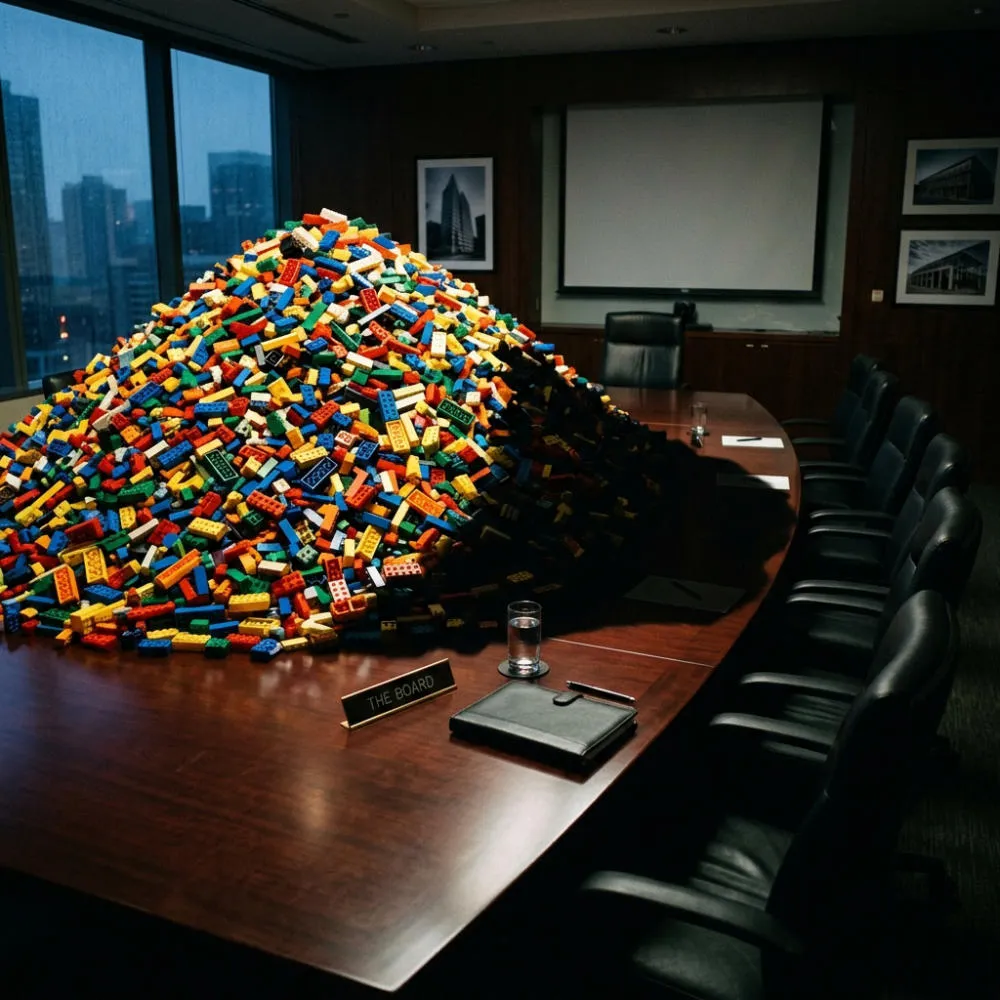
Imagine you inherit the most loved toy brand in the history of childhood. Generations of children have grown up with it. Parents buy it for their kids the same way their parents bought it for them. The name itself is synonymous with creativity, imagination, and the pure joy of building something from nothing. Now imagine watching that brand collapse in slow motion, unable to stop it.
This was the reality at Lego headquarters in Billund, Denmark, in 2003. Sales had fallen by 30% in a single year. The company was carrying $800 million in debt. Internal cash flow projections showed that Lego would completely run out of operating funds by late 2004 — eleven months away. The Lego family, who had built this empire from a small Danish carpentry workshop in 1932, was staring at the possibility that their grandfather’s dream would end on their watch.
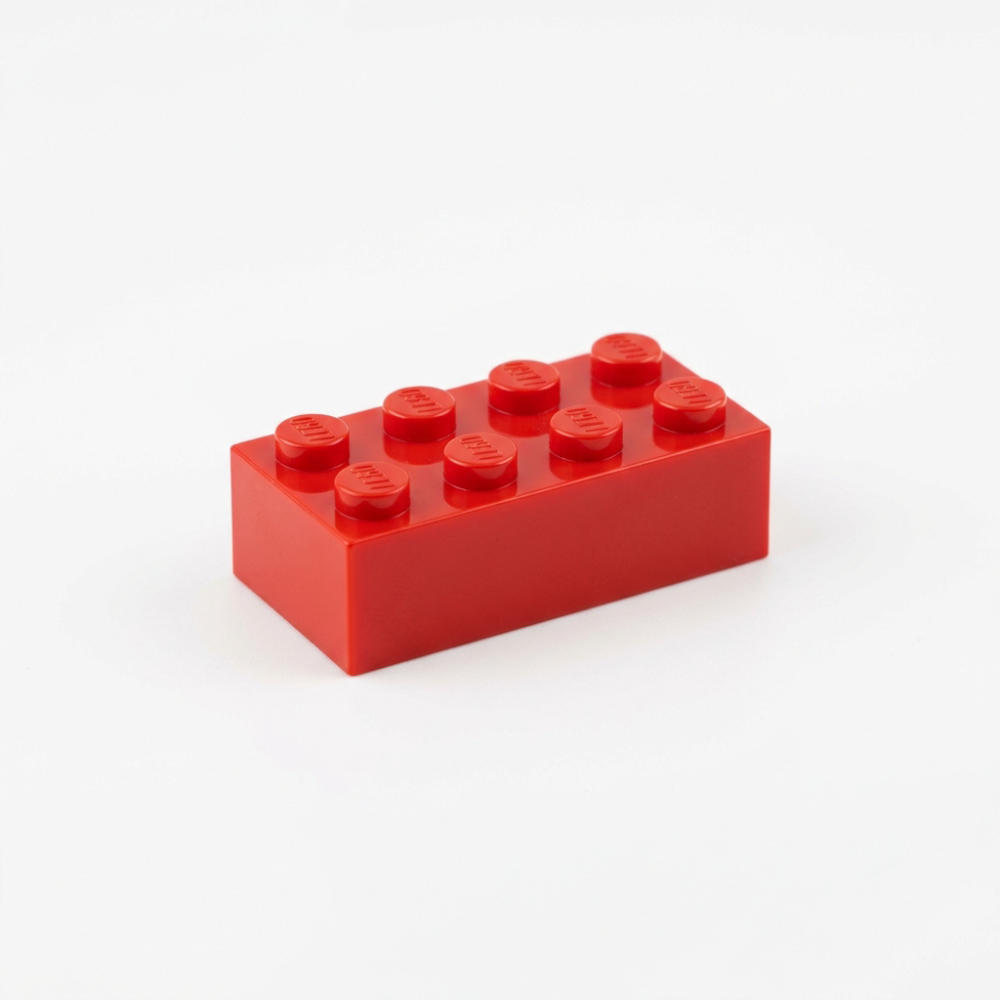
Going back to the basics — the single brick that saved the empire.
The crisis was entirely self-inflicted — and that made it more painful. In the late 1990s, Lego’s leadership became terrified of the digital gaming boom. PlayStation and Nintendo were pulling children away from physical toys, and Lego responded by panicking. They diversified wildly: Lego jewelry, Lego branded clothing, Lego action figures with over 50 unique moving parts, Lego video games, Lego television shows, and a massive global expansion of Legoland theme parks. They went from producing 6,000 different brick shapes to over 13,000 — each requiring expensive custom molds that sat idle when sets didn’t sell.
Core Competency
Strategic Management
Definition
A company’s defining capability that gives it competitive advantage — the thing it does better than anyone else in the world.
Real Example from This Story
Lego’s core competency is modular creative construction. Clothing, video games, and TV shows diluted this focus catastrophically.
Why It Matters
Every business decision should be evaluated against the core competency. Diversification that erodes it destroys value.
The result was catastrophic complexity. Their manufacturing costs exploded. Their designers had no creative constraints. Their supply chain became a logistical nightmare. The more they tried to be everything, the less they were anything.
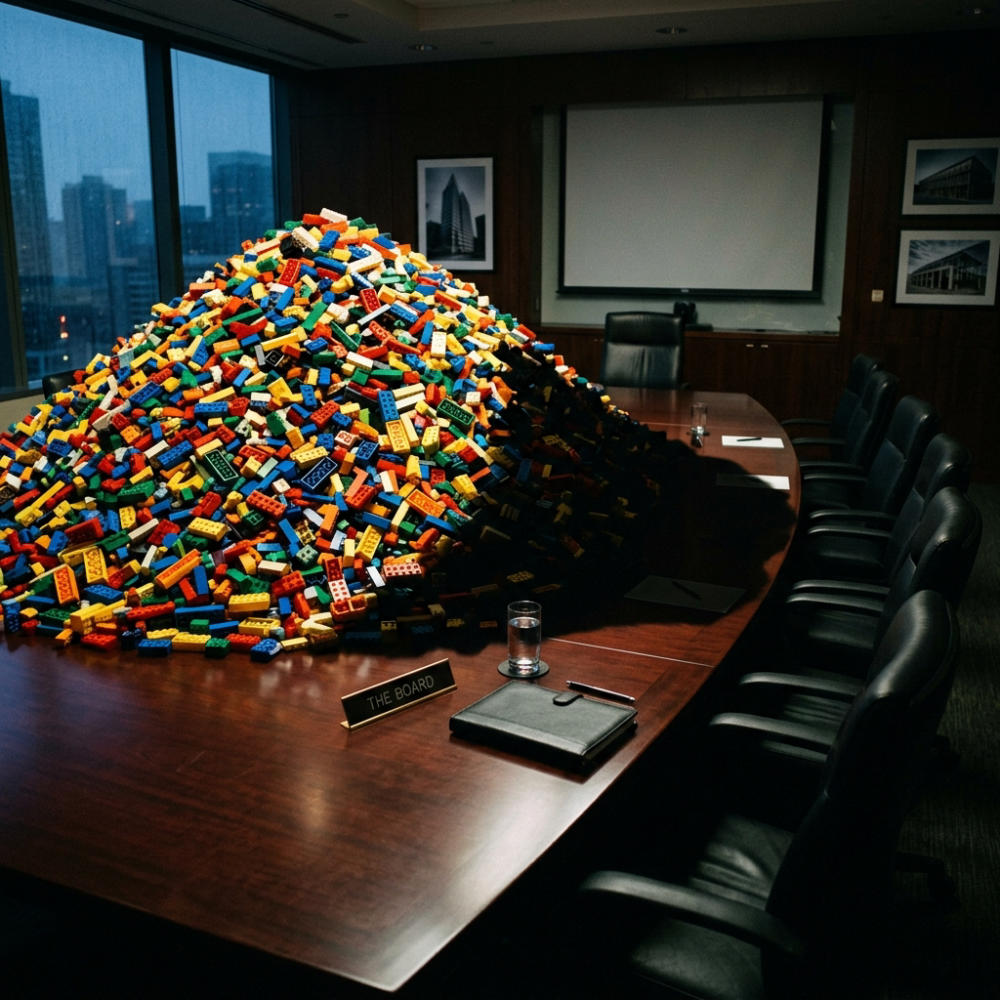
A mountain of unused complexity almost crushed the greatest toy company.
“We had forgotten what we were. We thought we needed to become something new. But the children hadn’t forgotten what Lego was. They were waiting for us to remember.”
— Jørgen Vig Knudstorp, CEO (2004–2017)
In October 2004, the Lego family appointed 35-year-old Jørgen Vig Knudstorp — a former McKinsey consultant with no toy industry experience — as CEO. His first act was to call every senior leader into a room and ask a simple question: “If we don’t change everything we’re doing, do we have a future?” The silence that followed told him everything.
Knudstorp’s strategy was almost surgical in its brutality. He sold 70% of the Legoland theme parks immediately to generate cash. He terminated the clothing line, the jewelry line, and dozens of product categories that had nothing to do with bricks. He reduced the brick component catalog from 13,000 shapes back to 6,000 — forcing designers to use creativity and constraints together, the way great Lego sets had always worked. He introduced a simple rule: every single product line must demonstrate a positive profit margin. No exceptions.
Brand Stretch
Brand Management
Definition
Extending a brand name into product categories unrelated to its original identity, risking dilution of the core brand.
Real Example from This Story
Lego jewelry, Lego clothing, and Lego theme parks were brand stretches so far from the core that they confused consumers and destroyed coherence.
Why It Matters
Brand stretch can generate short-term revenue but long-term brand confusion. The brand becomes associated with nothing specific.
Then he did something counterintuitive: he listened to adult Lego fans. He created formal research channels to understand what serious Lego enthusiasts wanted. He licensed intellectual properties — Star Wars, Harry Potter, Batman — turning cultural icons into building experiences that adults and children could share. And in 2014, The Lego Movie — a film built entirely on the premise that ordinary people with ordinary bricks can build extraordinary things — became a global phenomenon.

Every great comeback begins at the lowest possible point.
By 2015, Lego had surpassed Mattel and Hasbro to become the most profitable toy company on the planet. Revenue had grown from $1.3 billion in 2004 to $5.4 billion. The company that was 11 months from closure had become the largest toy company in the world. All it took was remembering that they were a brick company — and the courage to destroy everything else.
SKU Rationalization
Operations / Supply Chain
Definition
Reducing the number of product variants (SKUs) to cut complexity, reduce costs, and improve supply chain efficiency.
Real Example from This Story
Knudstorp reducing Lego brick types from 13,000 to 6,000 was aggressive SKU rationalization — it slashed mold costs and simplified manufacturing.
Why It Matters
Fewer SKUs mean lower inventory costs, simpler manufacturing, and clearer consumer decisions. Less is often more profitable.
Lego had 13,000 different brick shapes, a fashion line, video games, a theme park, and $800 million in debt. It was saved not by adding more — but by a 35-year-old who deleted almost everything.
What This Story Actually Teaches You
-
1
Diversification without discipline destroys the core. Lego forgot that their identity was a single brick — everything else was decoration. -
2
Complexity is the silent killer of profitability. 13,000 brick shapes vs 6,000 — the reduction saved the company. -
3
Great brands are defined by what they say NO to, not just what they say yes to. -
4
Community is a competitive moat: adult Lego fans who were ignored became the research team that rebuilt the brand. -
5
The strongest comeback strategy is often the simplest one: return to what made you great.
Lego is a perfect case study in Core Competency Theory (C.K. Prahalad and Gary Hamel, 1990). When Lego strayed from its core competency — creative structured play through bricks — it lost its competitive advantage. The moment Knudstorp refocused on that core, the company recovered.