Dallas, Texas. The year 2000. Reed Hastings and Marc Randolph, co-founders of a three-year-old DVD-by-mail startup called Netflix, have flown in for a meeting at Blockbuster’s corporate headquarters. They have requested the meeting with a clear purpose: they want Blockbuster to acquire Netflix for $50 million, and they want to run the company as Blockbuster’s online arm.
At this point, Netflix has 300,000 subscribers. It is not profitable. It is losing money on shipping costs and fighting for survival in a market where Blockbuster dominates entirely. Blockbuster has 9,000 stores in the United States, 60,000 employees, and 65 million registered customers. It is, by every measurable metric, the largest and most dominant force in entertainment rental history.
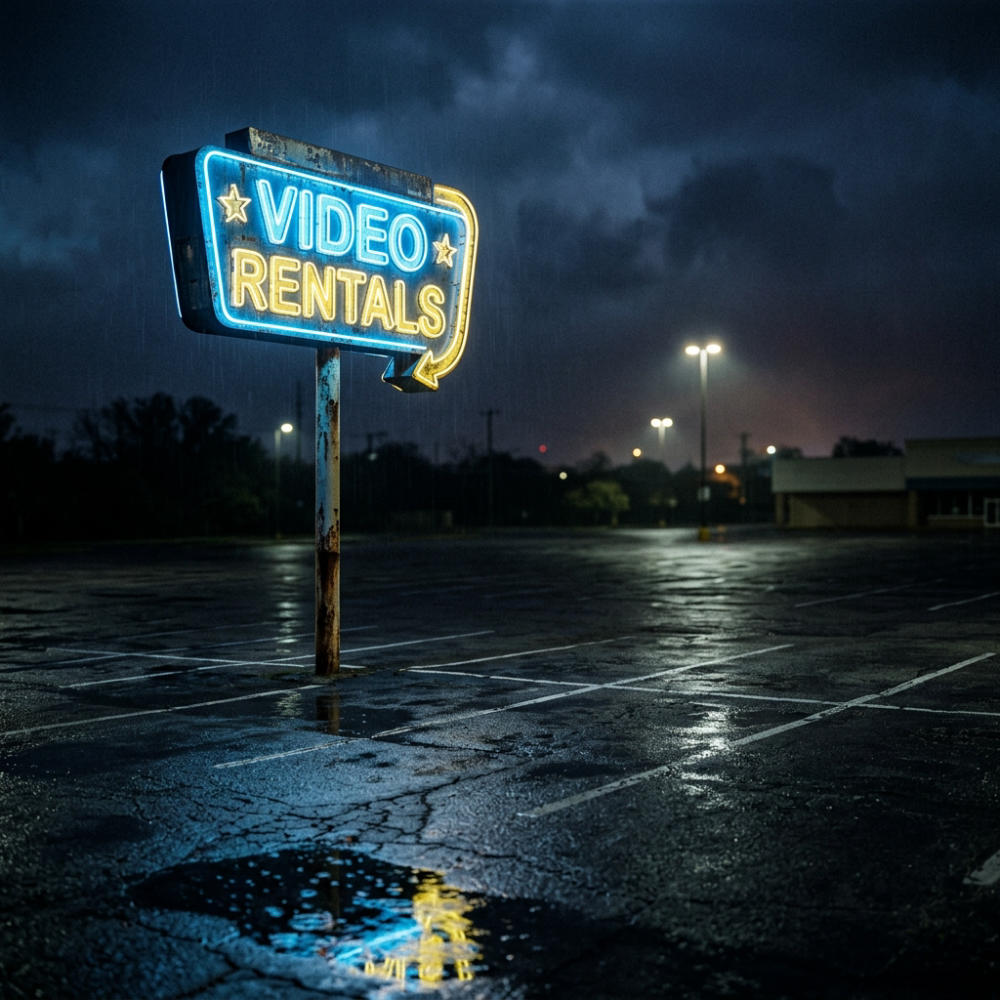
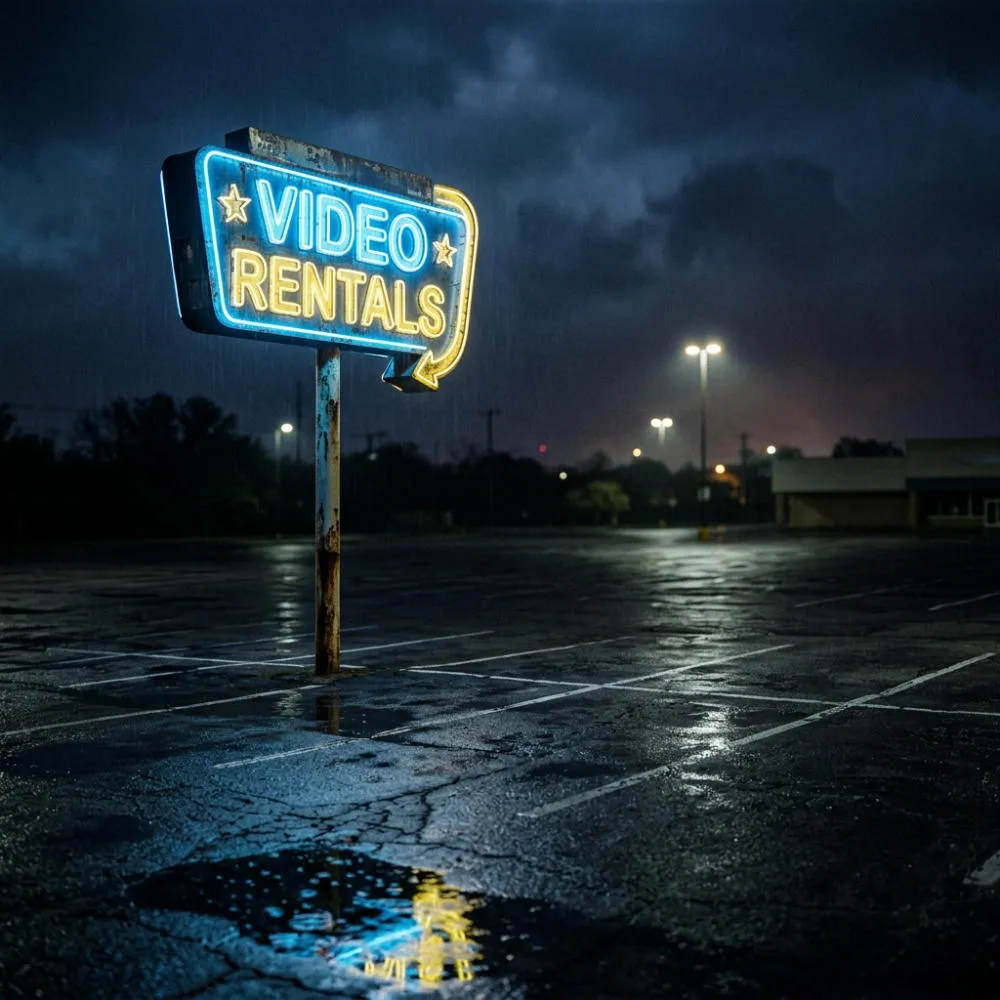
The blockbuster sign fading in an empty lot while streaming took over.
The Blockbuster executives listen to the pitch. Then, according to accounts from multiple sources who were present, they decline. The deal makes no sense to them — why would the world’s largest video rental company, with stores on every major street corner in America, need to pay $50 million for a money-losing mail-order DVD startup with 300,000 subscribers?
Innovator’s Dilemma
Disruptive Innovation
Definition
Clayton Christensen’s theory: successful companies fail because they correctly prioritize existing profitable customers over disruptive lower-margin innovations that eventually replace them.
Real Example from This Story
Blockbuster couldn’t cannibalize its $800M late fee revenue to compete with Netflix’s no-late-fee model — even though late fees were the #1 customer complaint.
Why It Matters
Understanding the innovator’s dilemma helps incumbents recognize when internal incentives are preventing necessary disruption.
John Antioco, Blockbuster’s CEO, reportedly found the meeting so unimpressive that he struggled to contain his amusement. Hastings and Randolph left the building without a deal.

The best marketing campaigns are the ones no one expected.
What Blockbuster’s executives did not understand — what, in fairness, almost nobody understood in 2000 — was that the internet was not just another distribution channel. It was a replacement for every distribution channel that had come before it. The physical store was not a strength to be protected; it was a liability about to become a catastrophic cost center as consumer behavior shifted toward digital convenience.
“They just about laughed us out of their office. At that point we had a small but quickly growing subscriber base, and they didn’t see the threat.”
— Marc Randolph, Netflix co-founder
Blockbuster did eventually try to compete in the online space. In 2004, under intense pressure from Netflix’s growing subscriber base, they launched Blockbuster Online. They were actually quite competitive for a brief period — at one point, Blockbuster Online was growing faster than Netflix. But their physical store infrastructure created impossible costs. The company’s private equity owners pressured them to eliminate the competitive features that were working. The window closed.
Switching Costs
Competitive Strategy
Definition
The friction — financial, psychological, or logistical — a customer faces when changing from one product or service to another.
Real Example from This Story
Blockbuster had low switching costs: once Netflix made rental convenient and cheaper, customers switched with almost zero friction.
Why It Matters
Low switching costs make markets highly vulnerable to disruption. High switching costs protect market share even from superior competitors.
Blockbuster filed for bankruptcy in 2010. The company that had been worth $6 billion in 1994 was sold in pieces for less than $350 million. Today, one Blockbuster store remains open in Bend, Oregon — kept running by its owner as a novelty attraction and cultural artifact. It sells merchandise commemorating what it represents: the most famous business mistake in modern entertainment history.

The underdog always has one advantage: nothing left to lose.
Netflix, the company that Blockbuster was offered for $50 million and declined to buy, is currently valued at approximately $280 billion. The $50 million that Blockbuster wouldn’t spend became a $280 billion lesson about the cost of laughing at the future.
Sunk Cost Fallacy
Decision Making
Definition
The tendency to continue investing in a failing strategy because of past investments, rather than evaluating current options objectively.
Real Example from This Story
Blockbuster kept investing in physical store upgrades long after digital was clearly winning — trapped by the sunk cost of existing infrastructure.
Why It Matters
The sunk cost fallacy kills companies that might otherwise adapt. Past investment is irrelevant to future decision-making.
In 2000, Netflix co-founders Reed Hastings and Marc Randolph flew to Blockbuster’s Dallas headquarters and offered to sell the company for $50 million. Blockbuster’s CEO reportedly laughed at them as they left.
What This Story Actually Teaches You
-
1
Laughing at a competitor’s business model is the most expensive mistake in business — it replaces analysis with contempt. -
2
Physical infrastructure that was once a competitive strength (9,000 stores) becomes a catastrophic cost center when the market shifts. -
3
The future was not hidden: the internet was clearly accelerating in 2000. Blockbuster’s failure was not ignorance — it was comfort. -
4
Netflix’s discipline during Blockbuster’s competitive response (eliminating late fees) shows how incumbent reactions can be weaponized. -
5
The one Blockbuster store remaining in Bend, Oregon earns more from merchandise commemorating its failure than it ever did from rentals.
Blockbuster is the defining case study in Innovator’s Dilemma (Clayton Christensen, 1997): a market-leading company fails not because it makes bad decisions, but because it makes *good decisions* that serve existing customers at the expense of adapting to disruptive new technologies.