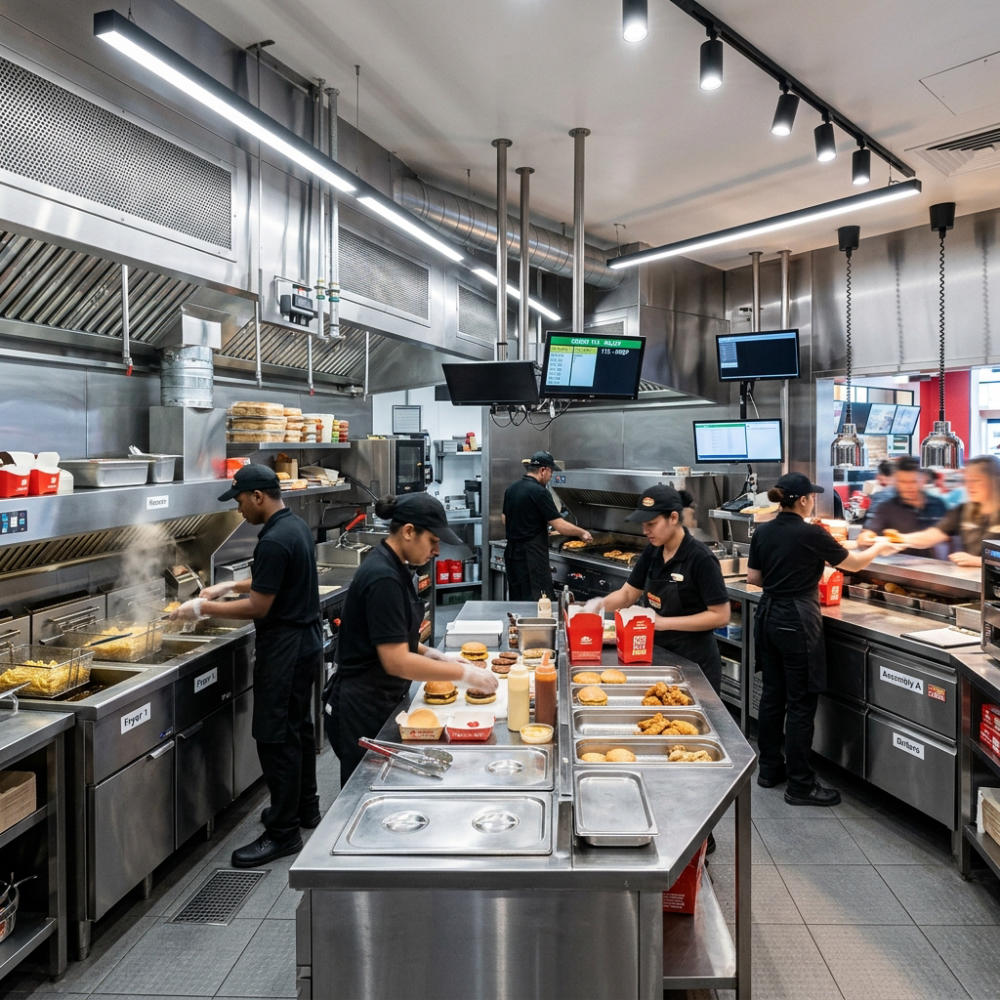
San Bernardino, California. 1948. Richard and Maurice McDonald are running a barbecue restaurant that is doing reasonably well. They have a problem, though: their operation is too slow, too complicated, and too dependent on skilled staff. They close the restaurant for three months and redesign everything from the ground up. They fire most of their staff. They reduce their menu to nine items. They create an assembly-line production system they call the “Speedee Service System” — the world’s first fast food kitchen.
Food is prepared in a precise sequence by specialized workers: one person just puts on the cheese, one person just adds the sauce, one person just wraps. Each task takes seconds. Orders come out in 30 seconds. Prices are half what competitors charge. The burger costs 15 cents. The lines outside the restaurant stretch down the block.
A pivotal moment in one of history’s most dramatic business stories.
By the early 1950s, the McDonald brothers have a genuine phenomenon on their hands. Newspapers write about them. Other restaurateurs visit to study their system. They begin franchising — slowly, carefully, to people they personally vet in their local area. They are happy. They are comfortable. They are not particularly interested in world domination. They are brothers who want to run a good business and enjoy their lives.
Founder-Market Fit
Startup Strategy
Definition
The alignment between a founder’s personal experience, skills, and obsessions with the specific market they are trying to disrupt.
Real Example from This Story
Phil Knight was a runner obsessed with running shoes. Jan Koum was an immigrant who needed cheap international messaging. Both had perfect founder-market fit.
Why It Matters
Founders with deep personal connection to the problem they’re solving have a natural insight advantage over outsiders and corporate teams.
In 1954, a 52-year-old milkshake machine salesman named Ray Kroc visits the restaurant to understand why it is ordering so many of his machines. He walks in and immediately sees something the brothers don’t see: a system that can be replicated everywhere. He smells money on a global scale that the McDonald brothers simply cannot imagine.
A pivotal moment in one of history’s most dramatic business stories.
Kroc convinces them to let him become their national franchising agent. He opens his first franchise in Des Plaines, Illinois, in 1955. He begins building franchises at a pace the brothers never anticipated. Arguments develop — about quality standards, about real estate strategy, about the pace of growth. The relationship deteriorates. Kroc wants to own and control everything. The brothers want to maintain their original careful, selective approach.
“If I had a brick for every time I’ve repeated the phrase Quality, Service, Cleanliness and Value, I think I’d probably be able to bridge the Atlantic Ocean with them.”
— Ray Kroc, McDonald’s Corporation founder
In 1961, Kroc buys out the McDonald brothers entirely for $2.7 million — approximately $1 million each after taxes. He promises them a 0.5% royalty on all future McDonald’s sales as part of the negotiation. He then consults his lawyers, who inform him that if he simply establishes a new McDonald’s Corporation as the controlling entity, the royalty agreement becomes legally unenforceable. He does exactly that. The brothers receive nothing beyond the initial $2.7 million.
Storytelling as Strategy
Marketing
Definition
Using narrative to communicate vision, values, and differentiation — creating emotional investment from investors, employees, and customers.
Real Example from This Story
Every iconic founder — Jobs, Schultz, Ambani — built companies on a story that preceded the product. The story attracted the believers who built the product.
Why It Matters
Stories are remembered 22× longer than facts (Stanford research). A compelling story is the cheapest and most durable marketing asset.
The original McDonald’s restaurant in San Bernardino — the brothers’ own location — was not included in the sale because they had retained the original site personally. Kroc opened a competing McDonald’s franchise one block away, deliberately. The brothers’ original restaurant eventually failed and was demolished. The site is now a small museum.

Most founders are told no before they change the world.
Richard McDonald died in 1998. His brother Maurice had died in 1971. Between them, they received $2.7 million for building one of the most replicable business systems ever created. McDonald’s Corporation today generates over $23 billion in annual revenue and is worth over $210 billion. The word “McDonald’s” appears on 40,000 restaurant signs in 100 countries. The brothers’ actual contribution to what that word represents is almost never mentioned in the company’s official history.
Richard and Maurice McDonald invented the fast food assembly line, the Happy Meal, and Golden Arches. They sold their entire stake for $2.7 million. Ray Kroc turned it into $210 billion and made sure they got almost none of the credit.
What This Story Actually Teaches You
-
1
The difference between a failed founder and a successful one is almost never intelligence — it is persistence through the specific valley between idea and market acceptance. -
2
Every successful founder carries a rejection story that would have stopped a less committed person. -
3
The founding story is the brand: what you were willing to sacrifice to build your company defines what your company stands for. -
4
The best founders are not the smartest people in the room — they are the most honest about what they don’t know. -
5
Building something from nothing requires the simultaneous management of total uncertainty and complete conviction.
Founder stories consistently demonstrate that the entrepreneurial advantage is not resources — it is resourcefulness. The ability to generate momentum from nothing, to convert believers with a story before a product exists, is the founder’s core skill.