
It is 1964. You are Phil Knight — 26 years old, fresh out of Stanford Business School, and absolutely consumed by one belief: that Japanese running shoes could destroy the American athletic market the same way Japanese cameras had destroyed the American camera industry. You are so certain of this that you have flown to Japan, walked into the offices of a shoe manufacturer called Onitsuka Tiger, and introduced yourself as the American representative of a company called Blue Ribbon Sports.
The problem: Blue Ribbon Sports does not exist. You made the name up in the cab on the way to the meeting.

Phil Knight’s “store” — a car boot, a folding table, and a dream.
You get the distribution deal anyway. Because Phil Knight has always had this terrifying ability to make people believe in things that don’t yet exist — including himself.
Product-Market Fit
Marketing Strategy
Definition
The degree to which a product satisfies a strong, pre-existing market demand. Achieved when customers buy repeatedly without being pushed.
Real Example from This Story
Track athletes buying every pair Knight brought to meets before he even had a proper store was Nike’s first proof of product-market fit.
Why It Matters
Marc Andreessen called it ‘the only thing that matters’ for a startup. Without it, all marketing is expensive noise.
Back in America, the reality is considerably less glamorous. Knight is working as an accountant at a Portland firm during the day. At night and on weekends, he loads boxes of Tiger running shoes into the trunk of his green Plymouth Valiant and drives to track meets across the Pacific Northwest. He sets up a folding table. He lifts the lid of a shoebox. He says: “These are the best running shoes you have ever seen.” And then he waits.

Bill Bowerman testing the waffle iron sole that changed athletic footwear forever.
Slowly, the runners come. They pick up the shoes. They turn them over. They put them on. And they can feel the difference immediately — the Tiger shoes are lighter, more responsive, more technically advanced than anything American brands were selling at the time. Knight sells every pair he brought. He drives home with an empty trunk and a pocket full of cash, and he orders more.
He applies to every bank in Portland for a business loan to scale up. Every single bank declines him. The loan officers look at his numbers — a part-time operation run from a car trunk, with no storefront, no staff, and no collateral — and they pass. Knight keeps going. His first employee, a former University of Oregon track coach named Bill Bowerman, contributes $500 and a revolutionary idea: a shoe sole with a waffle-iron pattern that would provide better traction. Bowerman had literally poured rubber into his wife’s waffle iron to test the concept.
Distribution Channel
Marketing Fundamentals
Definition
The path a product takes from the manufacturer to the end consumer. Can be direct (brand → customer) or indirect (brand → retailer → customer).
Real Example from This Story
Knight’s car trunk was the world’s most unconventional direct distribution channel — cutting out every retailer to reach athletes personally.
Why It Matters
Owning your distribution channel means owning your customer relationship. It’s a competitive moat most brands underestimate.
“The cowards never started and the weak died along the way. That leaves us, ladies and gentlemen. Us.”
— Phil Knight, to his early team
By 1971, Knight had renamed the company Nike, after the Greek goddess of victory. They hired a graphic design student named Carolyn Davidson to create a logo. She charged $35 for the now-iconic Swoosh. Knight looked at it and said he didn’t love it, but it would grow on him. It grew on the entire world.
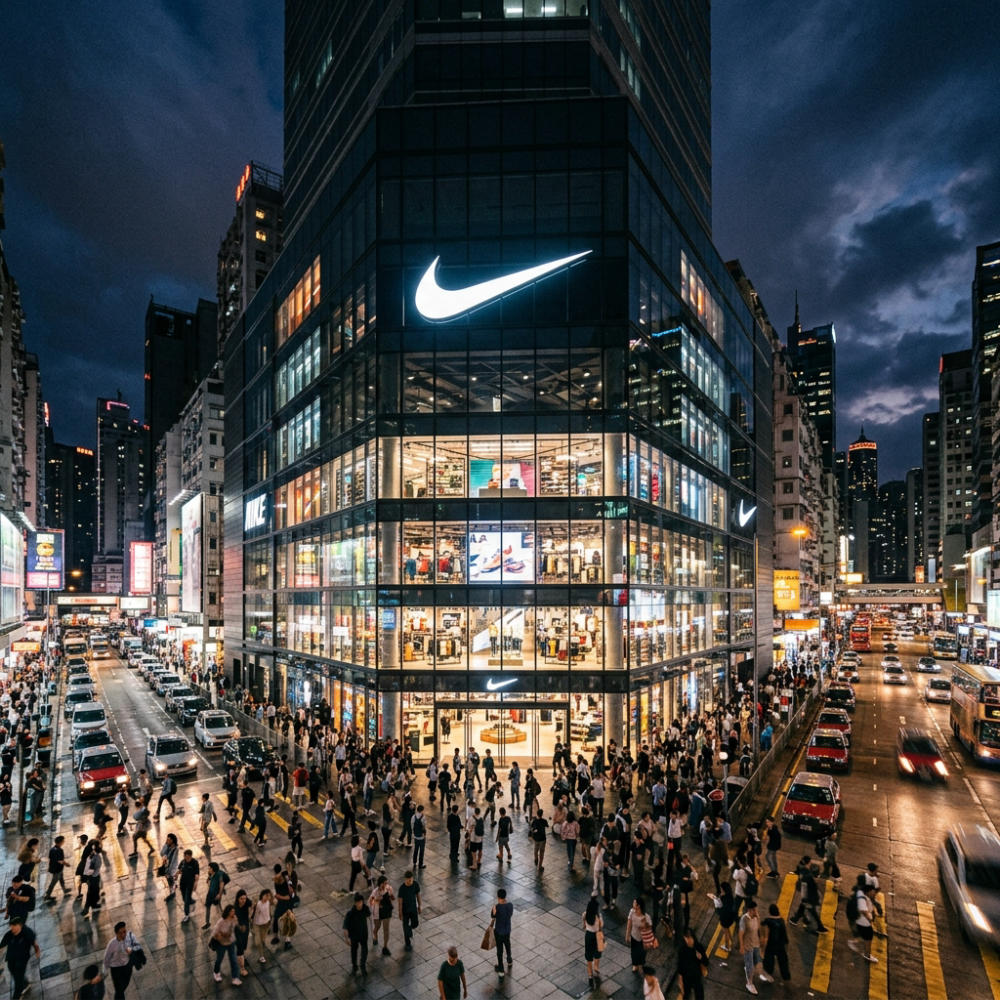
Nike’s global empire — built from a $35 logo and a borrowed recipe.
Today, Nike is worth over $32 billion in brand value alone. The man who couldn’t get a bank loan sells $51 billion in shoes per year. And the shoe with the waffle sole? It became the foundation of an entirely new category of athletic footwear. All of it started with a folding table, a trunk full of Japanese shoes, and a man with no investors who simply refused to stop.
Brand Equity
Brand Management
Definition
The commercial value derived from consumer perception of a brand, above and beyond the physical product’s value.
Real Example from This Story
A Nike-branded shoe commands $180. The same materials without the Swoosh might cost $30. That $150 difference is brand equity.
Why It Matters
Brand equity is the most durable competitive advantage. It takes decades to build and can outlast technology shifts.
Phil Knight sold running shoes from the trunk of his car at track meets. Banks called him a bad risk. His accountant told him to give up. He didn’t. You know the rest.
What This Story Actually Teaches You
-
1
The market you want to disrupt will almost never fund you — find believers outside the existing system. -
2
Distribution before brand: Knight built his customer base face-to-face before spending a dollar on advertising. -
3
The Swoosh cost $35. Brand equity today: $32 billion. The logo is not the brand — the story is the brand. -
4
217 of 242 investors said no. 25 said yes. You only need enough yes answers to start — not everyone’s approval. -
5
Product-market fit is discovered by going where the customer already is, not by waiting for them to find you.
Nike proves that grassroots distribution — getting your product in front of exactly the right person, in person — is often more powerful than any advertising campaign. Phil Knight didn’t market Nike. He demonstrated it, one runner at a time.