
You are 21 years old. You are a business student. You are watching a Pepsi television commercial that shows a teenager flying a $23 million military Harrier jump jet to school and landing it in the parking lot. At the bottom of the screen, in standard promotional text, it reads: “HARRIER FIGHTER — 7,000,000 PEPSI POINTS.”
Everyone else who watches this ad laughs and moves on. You open a calculator.
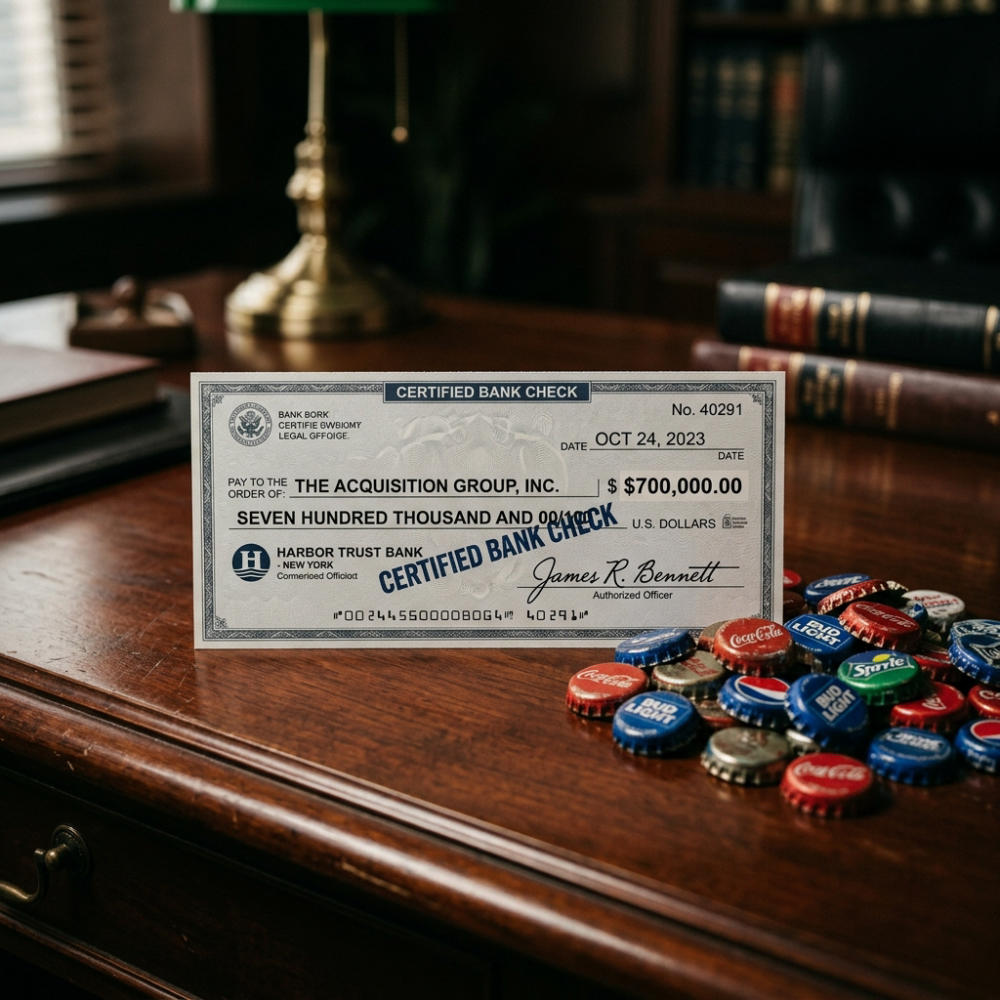
The $700,000 certified check that called Pepsi’s bluff.
This is the exact moment John Leonard became either the most creative consumer in American history or the most expensive headache in Pepsi’s corporate memory — depending on which side of the courtroom you’re sitting on.
Puffery
Advertising Law
Definition
Exaggerated promotional claims so obviously subjective or absurd that no reasonable person would take them as literal fact. Protected from false advertising laws.
Real Example from This Story
The Harrier jet ad was ruled ‘puffery’ — obviously humorous exaggeration. But Pepsi’s failure to clearly mark it as such cost them a trial.
Why It Matters
Understanding puffery vs. genuine offer is legally critical. Marketers must ensure humorous claims cannot be misread as contractual.
It was 1996. Pepsi had launched an aggressive loyalty program called “Pepsi Stuff.” Consumers collected points from bottle caps and can rings and could redeem them for branded merchandise — jackets, t-shirts, sunglasses. The TV ad was meant to be humorous, a dramatic exaggeration at the end of a fun promotional campaign. The Harrier jet was a joke. A punchline. Nobody at Pepsi gave it a second thought.

The Harrier jet that Pepsi accidentally offered for 7 million points.
Leonard gave it a great deal of thought. He read the fine print of the Pepsi Stuff rules and discovered a critical mechanism: consumers who had at least 15 points from Pepsi products could purchase additional points at 10 cents per point. This meant that the 7,000,000 points required to “claim” the Harrier jet could theoretically be purchased for $700,000 — a fraction of the jet’s actual $23 million market value.
Leonard did something extraordinary. He found five private investors who were willing to put up the $700,000 as a speculative investment. He sent Pepsi an official order form, accompanied by 15 original Pepsi Points, a certified bank check for $700,008.50 (the 10-cent point purchase plus the $8.50 listed shipping fee), and a formal letter demanding delivery of one McDonnell Douglas AV-8B Harrier II.
Offer and Acceptance
Contract Law / Marketing
Definition
The legal foundation of a contract: one party makes a clear offer, and another party accepts it on those exact terms.
Real Example from This Story
Leonard argued Pepsi made a public offer (the Harrier for 7M points) which he accepted on exact terms. The court disagreed — no reasonable offer existed.
Why It Matters
Every promotional campaign with a redemption mechanism creates potential contractual obligations. Legal review is not optional.
Pepsi’s legal team read the letter and had what can only be described as a very bad morning. They rejected the claim, returned the check, and sent a polite letter explaining that the commercial had been “clearly humorous.” Leonard responded by filing suit in federal court.

The best marketing campaigns are the ones no one expected.
“I didn’t think it was a joke. I thought it was a promotion. I applied the terms exactly as stated.”
— John Leonard, plaintiff
The case — Leonard v. Pepsico, Inc. — went to trial in 1999. Judge Kimba Wood of the Southern District of New York ruled definitively in Pepsi’s favor. Her ruling included language so vivid it is still quoted in business law classrooms today: she noted that the advertisement was “clearly fanciful,” that a military combat aircraft cannot be legally purchased by a civilian, and that the teenager depicted in the commercial was “clearly not of the age required to operate such a vehicle.” She concluded that “no objective person could reasonably have concluded that the commercial actually offered consumers a Harrier jet.”
Pepsi won. But the legal fees, reputational noise, and internal crisis that surrounded the case cost them far more than $700,000 — and changed how marketing and legal teams review every promotional campaign to this day. All because someone actually read the fine print.
Loyalty Program Economics
Customer Retention
Definition
The financial structure behind points-based reward programs — balancing breakage (unredeemed points), redemption costs, and customer lifetime value uplift.
Real Example from This Story
Pepsi Stuff worked because most consumers collect points but never redeem them. Leonard’s structured redemption attack exposed a flaw in their system design.
Why It Matters
Loyalty programs must be designed with clear redemption rules and value caps to prevent arbitrage by motivated consumers.
Pepsi’s commercial showed a military Harrier jet worth $23 million could be claimed for 7 million loyalty points. A 21-year-old business student found the loophole and tried to collect. What happened next became a Harvard Law case study.
What This Story Actually Teaches You
-
1
Legal language in marketing materials is not decorative — every promotional offer must be reviewed by legal teams before publication. -
2
Humor in advertising is high-risk: what seems obviously absurd to the creator may be taken literally by a motivated audience. -
3
The lawsuit cost Pepsi far more than the $700,000 Leonard had offered — in legal fees, PR management, and campaign redesigns. -
4
One creative, obsessive consumer can expose a gap between your intended message and your legal obligations. -
5
This case is now studied in every major law school as the precedent for ‘reasonable person’ standard in advertising contract law.
The Pepsi Harrier case is a masterclass in the gap between brand intention and legal liability. Every piece of marketing communication is also a legal document. The ‘reasonable person’ standard — whether a reasonable person would interpret an offer as genuine — is the legal test that saved Pepsi but cost them enormously.